Die Heinzelmännchen zu Köln / The Heinzelmännchen of Cologne (August Kopisch 1799–1853)
This ballad tells the story of the Heinzelmännchen, mysterious little household spirits, said to have lived in a distant past in Cölln (nowadays: Cologne), Germany. They secretly helped the city’s craftsmen by completing their work overnight with great diligence.
The poem remains popular for teaching the value of diligence, a virtue deeply rooted in German culture. The Heinzelmännchen legend has inspired children’s books, TV series (for instance the « Pumuckl », set in Munich), and numerous German companies and organizations using the name, for instance in cleaning facility services and social care.
1. Original
Wie war zu Cölln es doch vordem, Mit Heinzelmännchen so bequem! Denn, war man faul: …. man legte sich Hin auf die Bank und pflegte sich:
5 Da kamen bei Nacht, Ehe man’s gedacht, Die Männlein und schwärmten Und klappten und lärmten Und rupften
10 Und zupften Und hüpften und trabten Und putzten und schabten ….. Und eh ein Faulpelz noch erwacht, … War all sein Tagewerk ….. bereits gemacht!
einfaches Deutsch
Damals in Köln war es mit mit Heinzelmännchen so praktisch! Denn, wenn man faul war …. legte man sich auf die Bank und ruhte sich aus:
5 Dann kamen sie nachts, noch bevor jemand damit rechnete. Die kleinen Männchen waren überall unterwegs. Sie arbeiteten eifrig, machten dabei klappernde Geräusche und waren ziemlich laut. Sie rupften und zupften,
10 sprangen fröhlich umher, liefen geschäftig hin und her, putzten und schrubbten alles gründlich. Noch bevor der Faulpelz am Morgen aufwachte, war seine gesamte Arbeit bereits erledigt.
English
How wonderful life in Cologne used to be with the little Heinzelmännchen (house elves)! If someone was lazy, they simply lay down on a bench and relaxed.
5 Then, during the night, the little men would appear, before anyone even realized it. They bustled about, worked busily, made clattering noises,
10 They pulled and tugged, skipped and hurried around, cleaned and scrubbed. And before the lazy person woke up in the morning, all of their day’s work had already been done.
Köln (Cologne)& the Heinzelmännchen (household spirits)
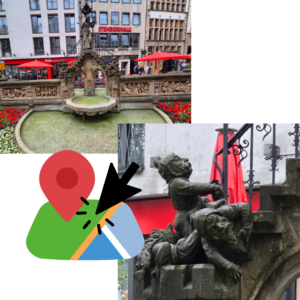
A fountain featuring statues of Little Helpers (Heinzelmännchen) near Cologne Cathedral, erected in honor of the 100th birthday of August Kopisch, the author of the ballad; image source: wikipedia
The ballad of the Heinzelmännchen was not invented by August Kopisch, but is based on a cologne folklore, which was also published by other authors (but not as rhymes, for instance Ernst Weyden: Cöln’s Vorzeit). Köln, which is now the fourth-largest city in Germany, has a long tradition of trade and craftsmanship. Thus, it’s no wonder it gave rise to tales about diligent house elves.
Even today you can make yourself on the traces of the Heinzelmännchen, for instance by visiting the Heinzelmännchenbrunnen, just around the corner of the Cologne Cathedral, which was added to the place in honour of the 100th birthday of the author August Kopisch, that had contributed to the city’s fame.
2. Original
15 Die Zimmerleute streckten sich Hin auf die Spän’ und reckten sich; Indessen kam die Heinzelmännchen Und sah was da zu zimmern war: Nahm Meißel und Beil.
20 Und die Säg’ in Eil: Sie sägten und stachen Und hieben und brachen, Berappten Und kappten,
25 Visirten wie Falken Und setzten die Balken ….. Eh sich’s der Zimmermann versah ….. Klapp, stand das ganze Haus … schon fertig da!
einfaches Deutsch
15 Die Zimmerleute machten eine kurze Pause und streckten sich. Währenddessen kam eine Gruppe von Heinzelmännchen. Sie sahen, dass ein Haus gebaut werden sollte, und nahmen sich Meißel, Beil
20 und Säge. Sie sägten, schnitzten, hackten und schlugen das Holz zurecht. Sie kürzten die Balken,
25 maßen alles ganz genau und bauten die Balken ein. Noch bevor der Zimmermann merkte, was passiert war, stand das ganze Haus schon fertig da.
English
15 The carpenters stretched themselves, Then reached toward the wood shavings; Meanwhile the host of spirits came To see what building there might be. They seized the chisel and the axe,
20 And quickly took the saw; They sawed and carved, They hacked and split, They trimmed And cut,
25 They measured like keen-eyed falcons, And set the beams in place… Before the carpenter knew what had happened— Bang! The whole house stood there, already complete!
Half-timbered houses « Fachwerkhäuser » in Köln
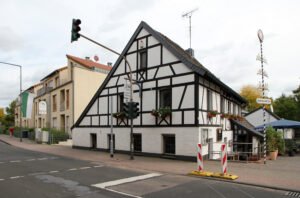
The Gasthaus Fühlingen features traditional German Fachwerk architecture and dates back to 1752. Although the restaurant closed in 2014, its beautiful façade can still be admired. Image source: Wikipedia.
This part refers to the half-timbered house (« Fachwerkhaus »), a typical German architectural style from the Middle Ages through the 19th century. Unlike modern construction, which uses predominantly bricks or prefabricated elements, half-timbered houses were built using wooden beams, such as oak, along with loam bricks und loam plaster. Therefore, this type of construction was not carried out by carpenters, skilled craftsmen specializing in woodwork (« Zimmermann » in German).
In Cologne, surviving half-timbered buildings from the eighteenth and nineteenth centuries are particularly associated with the city’s formerly rural villages and settlements. For example, the City of Cologne notes that half-timbered and brick buildings from these periods still shape the historic character of districts such as Libur and Weiß.
3. Original
Beim Bäckermeister war nicht Noth,
30 Die Heinzelmännchen backten Brodt. Die faulen Burschen legten sich, Die Heinzelmännchen regten sich – Und ächzten daher Mit den Säcken schwer!
35 Und kneteten tüchtig Und wogen es richtig Und hoben Und schoben Und fegten und backten
40 Und klopften und hackten. Die Burschen schnarchten noch im Chor: Da rückte schon das Brodt, … das neue, vor!
einfaches Deutsch
Der Bäckermeister hatte keine Sorgen,
30 denn die Heinzelmännchen backten das Brot für ihn. Während die faulen Bäckergesellen schliefen, machten sich die Heinzelmännchen an die Arbeit. Sie schleppten schwere Mehlsäcke,
35 kneteten den Teig kräftig, wogen die Zutaten genau ein. und trugen alles an den richtigen Platz. Sie fegten die Backstube und backten
40 und erledigten alle Arbeiten schnell und sorgfältig. Noch während die Gesellen tief und fest schnarchten, war das frische Brot schon fertig.
English
The master baker had no worries,
30 For the little household spirits baked the bread. The lazy apprentices lay down to rest; The little spirits sprang into action. Groaning beneath Their heavy sacks,
35 They kneaded with strength, And weighed everything just right; They lifted And carried, They swept and baked,
40 They pounded and chopped. While the apprentices were still snoring together, The fresh loaves were already coming out of the oven!
The diversity of bread in Germany has been officially registered as immaterial cultural heritage in Germany in 2014. The German Bread Institute maintains a national register ranging from Printen (a type of gingerbread) to classic breads, which accounts as of fall 2026 around 3500 entries. This registry is continuously expanded through new submissions from German guild bakers.
For the Rhineland, particularly the Cologne region, Rhenish black bread (Rheinisches Schwarzbrot) and Rhenish mixed bread / gray bread (Rheinisches Mischbrot / Graubrot) are traditional varieties. The Röggelchen, a small rye-based bread roll, is also particularly well known
The number of bakeries in German-speaking countries has been steadily declining for decades due to structural changes in the sector—such as the decline of small family-run businesses and the rise of bakery chains and hybrid bakery–café or bakery–restaurant concepts. At the same time, we can also observe, for instance, an increase in the number of bakeries offering Balkan-style bakery and pastry products.
4. Original
Beim Fleischer ging es just so zu: Gesell und Bursche lag in Ruh.
45 Indessen kamen die Männlein her Und hackten das Schwein die Kreuz und Quer. Das ging so geschwind, Wie die Mühl’ im Wind: Die klappten mit Beilen,
50 Die schnitzten an Speilen, Die spülten, Die wühlten Und mengten und mischten Und stopften und wischten.
55 That der Gesell die Augen auf: Schwups!- Hing die Wurst da schon im Schaufenster!
einfaches Deutsch
Beim Metzger (Fleischhauer) ging es ganz genauso zu: der Azubi und der Praktikant ruhten sich aus.
45 Währenddessen kamen die Heinzelmännchen, und hackten das Schwein in alle Richtungen in kleine Stücke. Sie machten das schnell, wie sich eine Mühle im Wind dreht. Die Beile klapperten geradezu,
50 Die schnitzten an Speilen, Die spülten, Die wühlten Und mengten und mischten Und stopften und wischten.
55 Als der Azubi seine Augen wieder öffnete, da hing die Wurst schon im Schaufenster im Ausverkauf!
English
At the butcher’s, it went just like this: The journeyman and the lad lay in peace.
45 Meanwhile, the little men came along and chopped the pig this way and that. It all happened so quickly, like a mill turning in the wind: Some chopped with axes, some carved on skewers,
50 some rinsed, some stirred, and they mixed and blended, and stuffed and wiped.
55 Then the trainee opened his eyes: Whoop! The sausage was already hanging there, ready for sale!
Similar to German baked goods, Germany also has a great variety of sausages and different meat products, ranging from various cuts of fillet to pork head and even Leberkäse.
In 2005, per-capita meat consumption was over 60 kilograms per person, while in 2025 it stood at around 55 kilograms per person. After years of decline, consumption reached a low point of around 53 kilograms per person in 2022. While pork consumption declined significantly, poultry consumption reached a record high of almost 15 kilograms per person.
While traditional dishes such as pork knuckle (Schweinshaxe) and Weißwurst, particularly during Oktoberfest, or Bockwurst at family barbecues, still remain popular, the consumption of döner kebab, dürüm, and similar fast-food dishes has also been steadily increasing since it’s invention in Berlin in 1972. By 2024, the market volume was estimated at €3.5–4 billion in annual revenue.