Der Werwolf / The werewolf (Christian MORGENSTERN 1907/1908)
This poem tells the story of a werewolf who sneaks out of his family home to seek information about the German grammar cases. He finds it in the local graveyard by consulting the spirit of a deceased village teacher.
Although it was written in the early nineteenth century, the poem was not published until 1981 by Diogenes publishing house in Zürich.
Even German-speaking children must learn the German case system and declension tables during their elementary education, but this poem offers a humorous and playful alternative. In it, the spirit of a deceased teacher declines the werewolf’s name: since Werewolf begins with « wer » (« who » in German), the poem turns a grammar lesson into a witty linguistic challenge.
✅ word-by-word guide: the original text – modern German version – English translation
✅ explanations about German grammar and vocabulary with links to other sources
✅ interpretation and other fun facts
In older German, “Weib und Kind” was a fixed expression referring to a man’s wife and children, essentially meaning his family as a whole. Today, however, the word “Weib” (“woman”) is considered derogatory and is often used as an insult. In earlier usage, though, it did not carry this negative connotation.
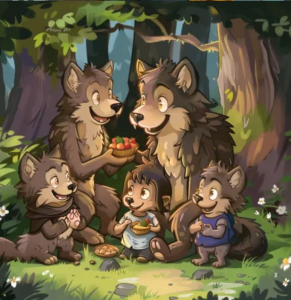
In German, “Weib und Kind” is fixed expression, a so-called Paarformel or Zwillingsformel, which is nowadays outdated/old-fashioned, referring to a man’s wife and children, essentially meaning his family as a whole. Today, however, the word “Weib” (“woman”) is considered derogatory and is often used as an insult. In earlier usage, though, it did not carry this negative connotation.
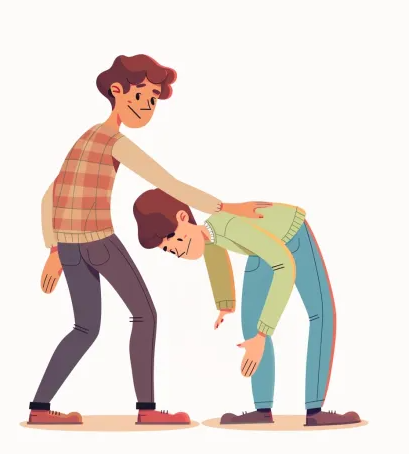
As children in school, we found the phrase „Bitte, beuge mich!“ (“Please, decline me!”) endlessly amusing, especially those of us with vivid imaginations. In a grammatical context, the expression refers to beugen in the sense of inflecting or declining a word—that is, giving its different grammatical cases (die Fälle beugen).
Outside of grammar, however, beugen can also mean “to bend” or “to bow.” Taken literally, „Bitte, beuge mich!“ sounds as though someone is asking to be physically bent or folded over. In reality, one can only bow oneself or bend down to pick something up from the ground. This led us to imagine absurd situations in which someone needed assistance to bow more elegantly or required a helping hand to bend down more easily, which naturally made the phrase a great source of amusement.🤣😄
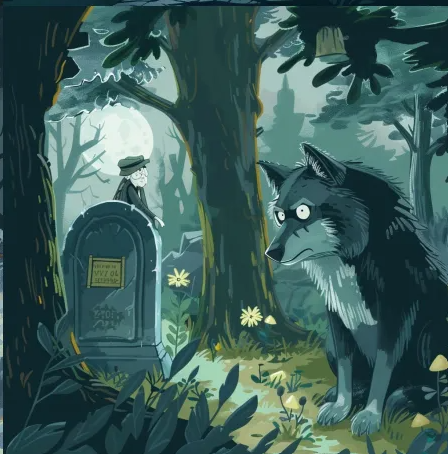
Interestingly, this poem provides very few additional details about the scenery. We know that the werewolf has a family, but we learn nothing about how they live. Was the graveyard cold or windy? What was the village teacher’s ghost wearing?
The only detailed description concerns the teacher’s grave site. On his grave there is a brass plaque (Blechschildschild) with a brass finial (Messingknauf), on which the ghost sat down to speak with the werewolf. Unfortunately, the image above, created by Midjourney, did not get all the details right. Therefore, here is a clearer description of what this metal plaque with a brass finial (Blechschild mit Messingknauf) might have looked like:

This is a linguistic joke: like in a declension table, the teacher inflects werewolf through different cases. In English, since wer means who, the equivalent playful forms could be something like:
In many languages, such as Hungarian and Latin, words change their form according to their grammatical role in a sentence. In German, this phenomenon survives only in the genitive case, where an -s is added to the end of the noun. English, by contrast, usually marks possession with an apostrophe and s (‘s).
To carry the joke further, here are some example sentences:
We have now reached the second part of the joke: the word wer (« who ») exists only in the singular, so there are no grammatical case forms for a plural « who. » The expression in großer Schar (« in great numbers ») is often used to refer to a large group of people, as in Kinderschar (« a crowd of children ») or Die Fans kamen in großer Schar zum Fußballspiel (« The fans arrived in large numbers for the football match »).
To be precise, however, wolves are not organized into a Schar but into a Rudel—a wolf pack.
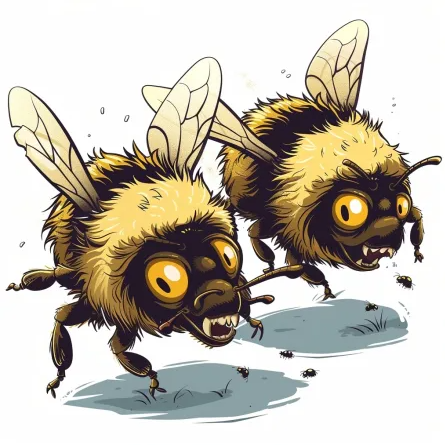
Other collective terms in the animal kingdom include a herd of cattle (Kuhherde), a pod of dolphins (Delfinschule) and a swarm of bees (Bienenschwarm).
What would happen if we imagined bees forming a pack (ein Bienenrudel) rather than a swarm? To native speakers, this gives the bees a more predatory character.🫢
This poem not only offers a playful way to learn German grammar, but also reveals the character traits of both the werewolf and the village schoolteacher. The teacher does not invent new grammatical cases simply to satisfy the werewolf’s curiosity; instead, he gives a correct and knowledgeable answer, even though it is disappointing. Years ago, this might have seemed like a minor detail hardly worth mentioning. Today, however, in an age when AI algorithms sometimes fabricate facts, so-called « hallucinations », it serves as a striking and somewhat unsettlingreminder of the value of honesty and intellectual integrity.
The werewolf, for his part, accepts this devastating news with remarkable humility. Though it brings him to tears and leaves him « tränenblind » (« blind with tears »), he remains thankful for the explanation. It’s delightful that Morgenstern uses the poem’s final two lines to pivot swiftly toward a happy ending while conveying a gentle lesson about coping with disappointment.
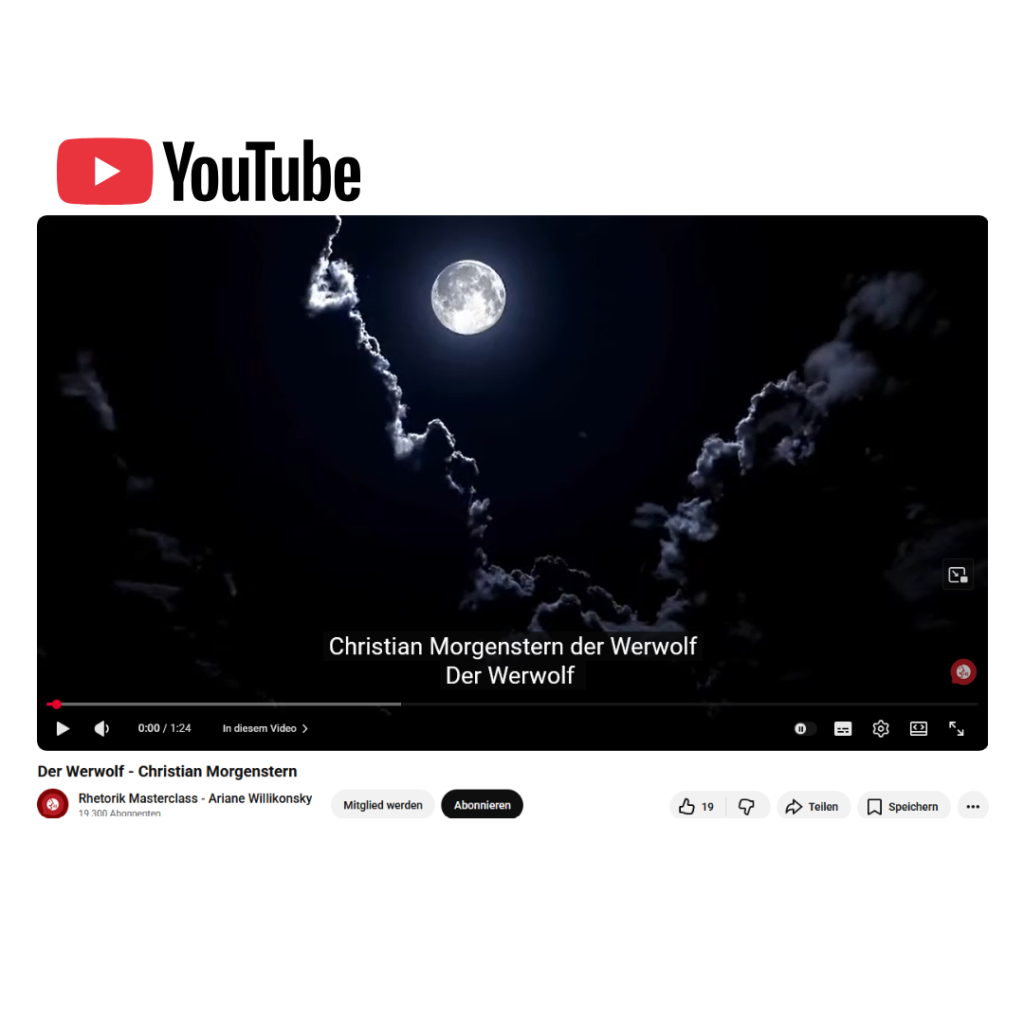
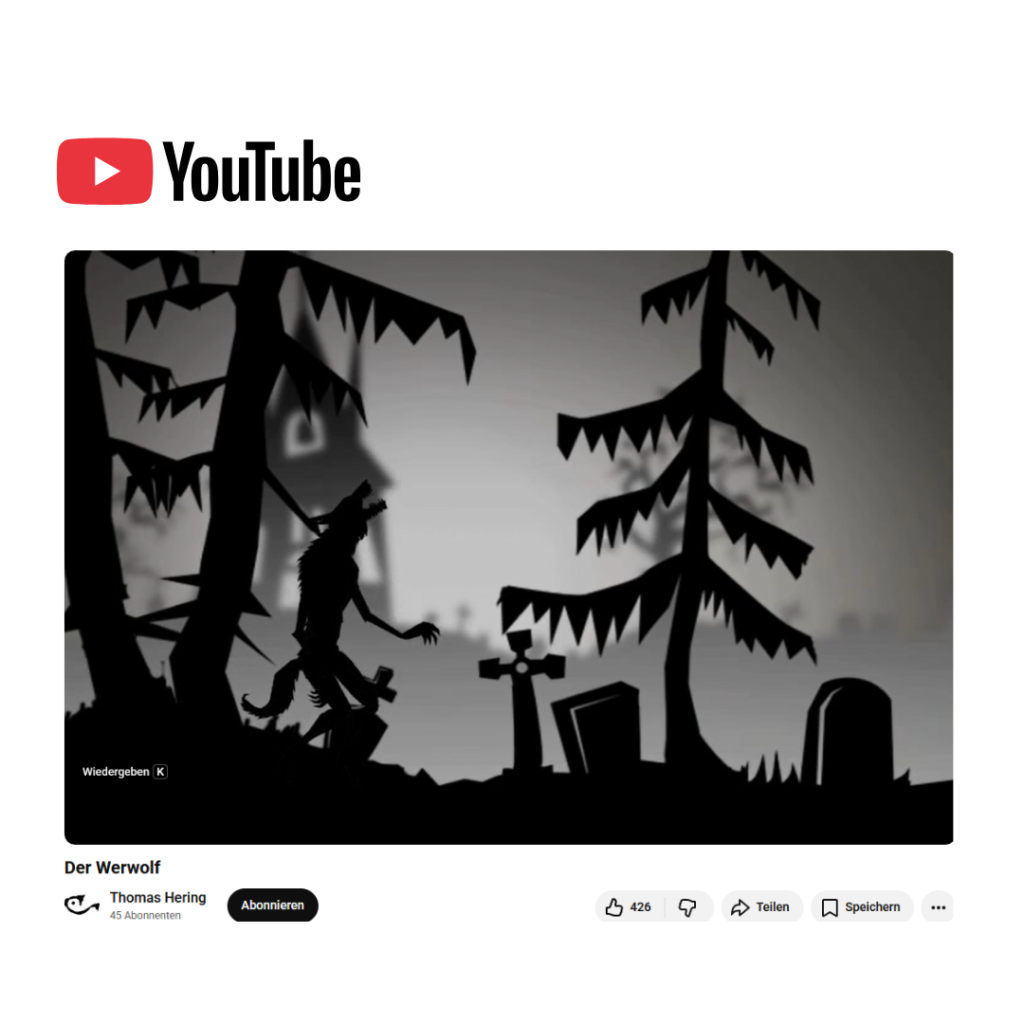
Like many other classical poems, this poem is recited and has been adapted into short films and songs:

Christian Morgenstern not only wrote poetry in German but also translated the works of other authors, such as the Norwegian Henrik Ibsen (e.g., Peer Gynt).
From another poem, Die unmögliche Tatsache (published 1905 in the poem volume Galgenlieder), the words « Weil nicht sein kann, was nicht sein darf » (« Because what must not be cannot be« ) are commonly used in everyday language, to describe situations of ignoring of inconvenient facts or truths.
Examples: