« Das Riesenspielzeug » is charming little ballad about a giant girl who mistakes a farmer for a toy is a classic in classrooms throughout German-speaking region, around the ages of 11 – 16, but also heard in recitals. Below you’ll find detailed translations in modern German and English as well as interesting fun facts and economic information.
Notable aspects of this poem include ancient word choice in comparison to nowadays, the historical context of the region where the story is set (culturally and economically, a blend of German and French), the father-daughter relationship and the importance of respect towards other people
✅ word-by-word guide: the original text – modern German version – English translation
✅ explanations about German grammar and vocabulary with links to other sources
✅ tourism/culinary information as well as study, research and job market opportunities for German speakers in the region.🍷🧑🎓👨🔬👩🏽💼
1. Original
Burg Niedeck ist im Elsaß der Sage wohl bekannt, Die Höhe, wo vor Zeiten die Burg der Riesen stand; Sie selbst ist nun verfallen, die Stätte wüst und leer, Du fragest nach den Riesen, du findest sie nicht mehr.
einfaches Deutsch
Die Burg Niedeck ist in den Legenden des Elsass wohlbekannt, Der Hügel, auf dem einst die Burg der Riesen stand; Die Burg selbst ist nun eine Ruine, der Ort ist verwildert und leer, Du fragst nach den Riesen, doch du wirst sie nicht mehr finden.
English
Niedeck Castle is well known in the legends of Alsace, The hill where, long ago, the giants’ castle stood; The castle itself is now in ruins, the site desolate and empty, You ask about the giants, but you will find them no more.
Der Elsaß (Alsace)
The very first words of this ballad grab the reader’s attention:
Unlike other stories or poems where there aren’t any specific references to the location, e.g., in a « distant kingdom » or in a « village in the Alps », etc., a specific region – the Alsace- is mentioned.
Alsace (Elsaß) is a border region between France and Germany that has belonged to both countries at different times. When this poem was written, the region, which is now part of France, belonged to Germany. Like watercolor paint that gently diffuses beyond the edges of the paper, language does not stop abruptly at political borders. To this day, the Alsatian-German dialect continues to be spoken in the region. For example, the word for plum (Quetsche d’Alsace) is « Zwatschga » or « Zwetschga » rather than the Standard German Zwetschge.
The ruins of Niedeck Castle/Château du Nideck (image source wikipedia:Burg Niedeck) can still be visited – after a challenging hike up the hill.
Moreover, the Alsace region—centered around Strasbourg and Mulhouse—forms a powerful cross-border economic hub with Freiburg and Karlsruhe in Germany, and Basel in Switzerland. It is also home to « Eucor – The European Campus », a university alliance that promotes international education and research.
Thus, the region is an attractive destination for German speakers in general, whether native or proficient, as it offers access to the economic advantages and labor markets of three countries.
Einst kam das Riesen-Fräulein aus jener Burg hervor, Erging sich sonder Wartung und spielend vor dem Thor Und stieg hinab den Abhang bis in das Thal hinein, Neugierig zu erkunden, wie’s unten möchte sein.
einfaches Deutsch
Einst kam das Riesenmädchen aus jener Burg heraus, vergnügte sich ganz ohne Sorge und spielte vor dem Tor, stieg den Abhang hinunter bis ins Tal, um neugierig zu sehen, wie es dort unten aussieht.
English
Once upon a time, the giantess emerged from that castle, Wandering aimlessly and playing before the gate, And made her way down the slope into the valley, Curious to discover what it might be like down below.
Typical for the works at this time, the early 19th century, in the German language the ‘th’ is still used as in Thor (door, which today would be written as Tor) or Thal (valley, which is written as Tal in modern German). The ‘th’ towards ‘t’ spelling got adapted during the II. Orthographischen Konferenz in 1901.
3. Original
Mit wen’gen raschen Schritten durchkreuzte sie den Wald, Erreichte gegen Haslach das Land der Menschen bald, Und Städte dort und Dörfer und das bestellte Feld Erschienen ihren Augen gar eine fremde Welt
einfaches Deutsch
Mit wenigen schnellen Schritten durchquerte sie den Wald, und erreichte bald bei Haslach das Land der Menschen. Die Städte und Dörfer dort sowie die bewirtschafteten Felder erschienen ihr wie eine völlig fremde Welt.
English
In a few quick strides, she crossed the forest and soon reached the land of humans near Haslach. The towns and villages there, as well as the cultivated fields, seemed to her like a completely alien world.
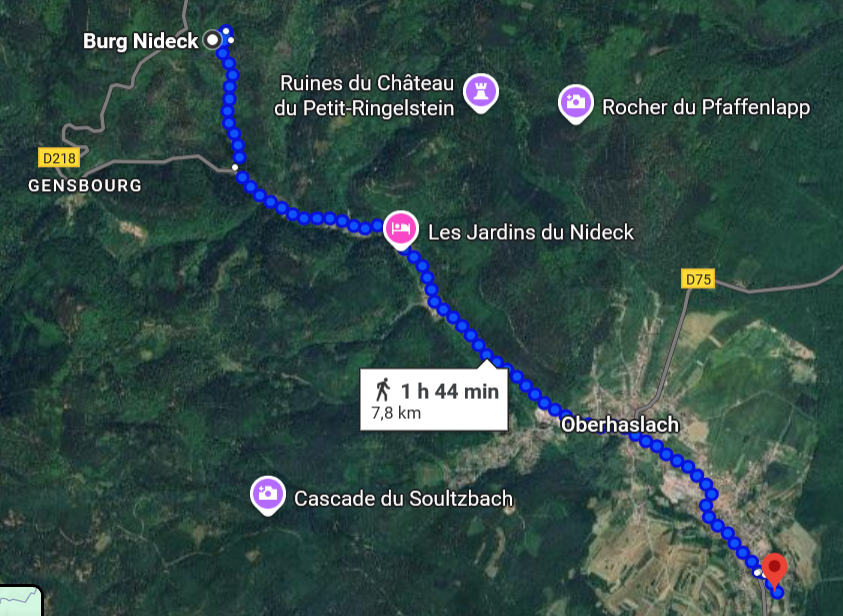
In fact, there is an Oberhaslach and a Niederhaslach near Niedeck Castle. Did the little giantess in the story perhaps take the Rue du Nideck?
If we were to take this route today, it would take us almost two hours, perhaps a little less going downhill… and for a giantess, it was just a few quick steps (« Mit wen’gen raschen Schritten… »).
4. Original
Wie jetzt zu ihren Füßen sie spähend niederschaut, Bemerkt sie einen Bauer, der seinen Acker baut; Es kriecht das kleine Wesen einher so sonderbar, Es glitzert in der Sonne der Pflug so blank und klar.
einfaches Deutsch
Als sie auf ihre Füße hinunterblickt und aufmerksam hinschaut, bemerkt sie einen Bauern, der sein Feld pflügt; das kleine Tierchen kriecht so seltsam dahin, der Pflug glänzt so hell und klar in der Sonne.
English
As she looks down at her feet, peering intently, She notices a farmer tilling his field; The little creature crawls along so strangely, The plough glitters so brightly and clearly in the sun.
While new words are added to the dictionary every year(including the « words of the year »), « einherkriechen » is a counterexample: it does not exist in the Duden dictionary (« hineinkriechen » does, however). Here in the text, it can be equated with « walking around. » But since humans are so small compared to the giantess, they are comparable to small animals crawling around…
5. Original
Ei! artig Spielding! ruft sie, das nehm’ ich mit nach Haus. Sie knieet nieder, spreitet behend ihr Tüchlein aus, Und feget mit den Händen, was da sich alles regt, Zu Haufen in das Tüchlein, das sie zusammen schlägt;
einfaches Deutsch
„Oh! Was für ein tolles Spielzeug!“, ruft sie, „das nehme ich mit nach Hause.“ Sie kniet sich hin, breitet geschickt ihr kleines Tuch aus, und kehrt mit den Händen alles, was sich dort bewegt, auf das Tuch, das sie zusammenfaltet;
English
“Oh! What a lovely little toy!” she cries, “I’ll take this home with me.” She kneels down, deftly spreads out her little cloth, And sweeps up with her hands everything that’s moving there, Into a heap on the cloth, which she folds up;
Over time, some words undergo semantic change, either shifting in meaning or acquiring different connotations. For example, the German word Weib, which simply meant « woman » or « wife » for many centuries, was originally neutral in meaning. Today, however, it is generally perceived as derogatory and can function as an insult, as in the expression dummes Weib (« stupid woman »).
A similar development can be observed with the adjective artig. One of its older meanings, « fine, » « excellent, » or « neat, » still exists but is now considered old-fashioned and is rarely used in contemporary German. Its other meaning, « well-behaved » or « well-mannered, » remains common today. Examples include artige Kinder (« well-behaved children ») and the question Kinder, wart ihr brav und artig? (« Children, have you been good and well-behaved? »).
Thus, to sum up this four-line stanza, we can conclude that the giant young lady (Riesenfräulein) was not very artig (« well-behaved« ) when she wrapped up her new artiges (« delightful » or « fine ») toy—the farmer and his farming implements—in a cloth and carried it home with her.
6. Original
Und eilt mit freud’gen Sprüngen, man weiß, wie Kinder sind, Zur Burg hinan und suchet den Vater auf geschwind: Ei Vater, lieber Vater, ein Spielding wunderschön! So Allerliebstes sah ich noch nie auf unsern Höh’n.
einfaches Deutsch
Und sie eilt mit fröhlichen Sprüngen zum Schloss hinauf – man weiß, wie Kinder sind – und sucht schnell ihren Vater auf: „Oh Vater, lieber Vater, was für ein wunderschönes Spielzeug! So etwas Schönes habe ich auf unseren Hügeln noch nie gesehen.“
English
And she hurries up to the castle with joyful leaps—you know how children are— And quickly seeks out her father: « Oh Father, dear Father, what a beautiful toy! I’ve never seen anything so lovely on our hills. »
It’s not only the choice of words that craft a story but also the little commentaries – you know how children are – in between that make a story vivid and sheds a light on relationships between the different characters and draws the reader in even further.
7. Original
Der Alte saß am Tische und trank den kühlen Wein, Er schaut sie an behaglich, er fragt das Töchterlein: Was Zappeliges bringst du in deinem Tuch herbei? Du hüpfest ja vor Freuden; laß sehen, was es sei.
einfaches Deutsch
Der alte Mann saß am Tisch und trank den kühlen Wein, er sah sie liebevoll an und fragte seine kleine Tochter: Was für ein kleines Päckchen bringst du da in deinem Tuch herbei? Du hüpfst vor Freude; lass mich mal sehen, was es ist.
English
The old man sat at the table drinking the cool wine, He looked at her fondly and asked his little daughter: What little bundle are you bringing here in your shawl? You’re jumping for joy; let me see what it is.
Setting the scene/ the importance of adjectives and adverbes: The girl found her father, the « old (man) » at the table and is drinking (or even enjoying…) his cold wine. While at the time of Chamisso the education of children is rather strict and potentially more emotional distant that nowadays, the father looks at his daughter fondly (« behaglich »). Moreover you can feel the curiosity of the father seeing his daughter this enthusiastic.
The world-class wines of Alsace
The Alsace region is home to countless vineyards producing world-class wines protected under the EU’s Protected Designation of Origin (PDO) certification system. As of May 2026, the region counts 51 individually registered Alsace Grand Cru PDOs. Grand Cru wines must come from one specific named vineyard, producing expectional quality wines at controlled quantity. The closest Grand Cru vineyard to Nideck Castle is the Alsace Grand Cru Bruderthal. In addition to these Grand Crus, Alsace also includes two broader PDO appellations: Alsace and Crémant d’Alsace. The region is further known for the Heiligenstein Klevener AOC (controlled designation of origin), as well as the late-harvest wines (Vendanges Tardives) and the « Sélection de Grains Nobles ». The latter are made from individually selected grapes affected by noble rot, yielding intensely sweet, highly aromatic wines.
8. Original
Sie spreitet aus das Tüchlein und fängt behutsam an, Den Bauer aufzustellen, den Pflug und das Gespann; Wie alles auf dem Tische sie zierlich aufgebaut, So klatscht sie in die Hände und springt und jubelt laut.
einfaches Deutsch
Sie breitet das kleine Tuch aus und beginnt behutsam, den Bauern, den Pflug und das Gespann aufzustellen; Sobald sie alles ordentlich auf dem Tisch angeordnet hat, klatscht sie in die Hände, springt auf und jubelt laut.
English
She spreads out the little cloth and gently begins To arrange the farmer, the plough and the team; Once she has arranged everything neatly on the table, She claps her hands, jumps up and cheers loudly.
9. Original
Der Alte wird gar ernsthaft und wiegt sein Haupt und spricht: Was hast du angerichtet? das ist kein Spielzeug nicht! Wo du es hergenommen, da trag’ es wieder hin, Der Bauer ist kein Spielzeug, was kommt dir in den Sinn!
einfaches Deutsch
Der alte Mann wird ganz ernst, schüttelt den Kopf und sagt: Was hast du da getan? Das ist kein Spielzeug! Bring es zurück dorthin, wo du es gefunden hast, Der Bauer ist kein Spielzeug – was hast du dir nur dabei gedacht!
English
The old man grows quite serious, shakes his head and says: What have you done? This is no toy! Take it back to where you found it, The farmer is no toy – what on earth were you thinking!
Here you can see the mood shifting: There’s not much left of the cosy warmth or enthusiasmus from the previous verses, instead now the reader feels the seriousness of the matter. And as the father explains to the daughter, the reader to learns something. Thus the Chamisso chooses an indirect way to educate the readers instead of « one should always » or « one should never », the moral message is transported via the conversation between a father and a daughter (which, as seen before, share a loving bond rather than a cold, distant one). This stylistic decision makes the message seem more innocent and yet doesn’t take away any of it’s seriousness, instructiveness given the choice of words in the next verse if even mentioning « god behold… »
Interestingly, there’re two synonymes for « toy » in the story: The little giantess uses « Spielding » and her father uses « Spielzeug ». While the word « Spielzeug » is still used today, « Spielding » has fallen out of fashion. However both parts « Zeug » and « Ding » can be found nowadays: « Ding » is in general « a thing », whereas « Zeug » describes the plural of things, similar to « stuff ». For instance, « put away your stuff » translates into « räum dein Zeug weg » (used coloquially).
10. Original
Sollst gleich und ohne Murren erfüllen mein Gebot; Denn, wäre nicht der Bauer, so hättest du kein Brod; Es sprießt der Stamm der Riesen aus Bauernmark hervor, Der Bauer ist kein Spielzeug, da sei uns Gott davor!
einfaches Deutsch
Du musst meinem Befehl sofort und ohne Widerrede gehorchen; Denn ohne den Bauern hättest du kein Brot; Das Geschlecht der Riesen entspringt dem Boden des Bauern, Der Bauer ist kein Spielzeug – Gott bewahre!
English
You must obey my command at once and without complaint; For were it not for the farmer, you would have no bread; The race of giants springs forth from the soil of the farmer, The farmer is no plaything—God forbid!
The phrase « Denn, wäre nicht der Bauer, so hättest du kein Brod » (if it wasn’t for the farmer, you wouldn’t have bread) is the moral of the story. Didactically, this phrase was used to practice emphasis (stress) and seriousness in the voice, with the emphasis placed on « du » (you)
As bread is the staple food, it also translates to having to go hungry without it. The phrase is also often revered to in situations where someone looks down on other professions that are seemingly not as glamorous or reputable as others, in a reminder that the work done is essential and just as honorable. It is even explained that the giants in the castle once came from farmers too.
Which dynasties decent from farmers ?
Many empiral dynasties see their (mythical) roots as decendents from gods such as the ancient egyptians or the Japanese dynasty. But the opposition is true as well, such as the Chinese Han-Dynastie (Liu Bang漢劉邦) , the Ming-Dynasty (Zhu Yuanzhang, 洪武帝) or the Zulu-kingdom of Shaka Zulu (Shaka kaSenzangakhona). The Swedish monarchy has its roots in French middle-class (Jean-Baptiste Bernadotte)
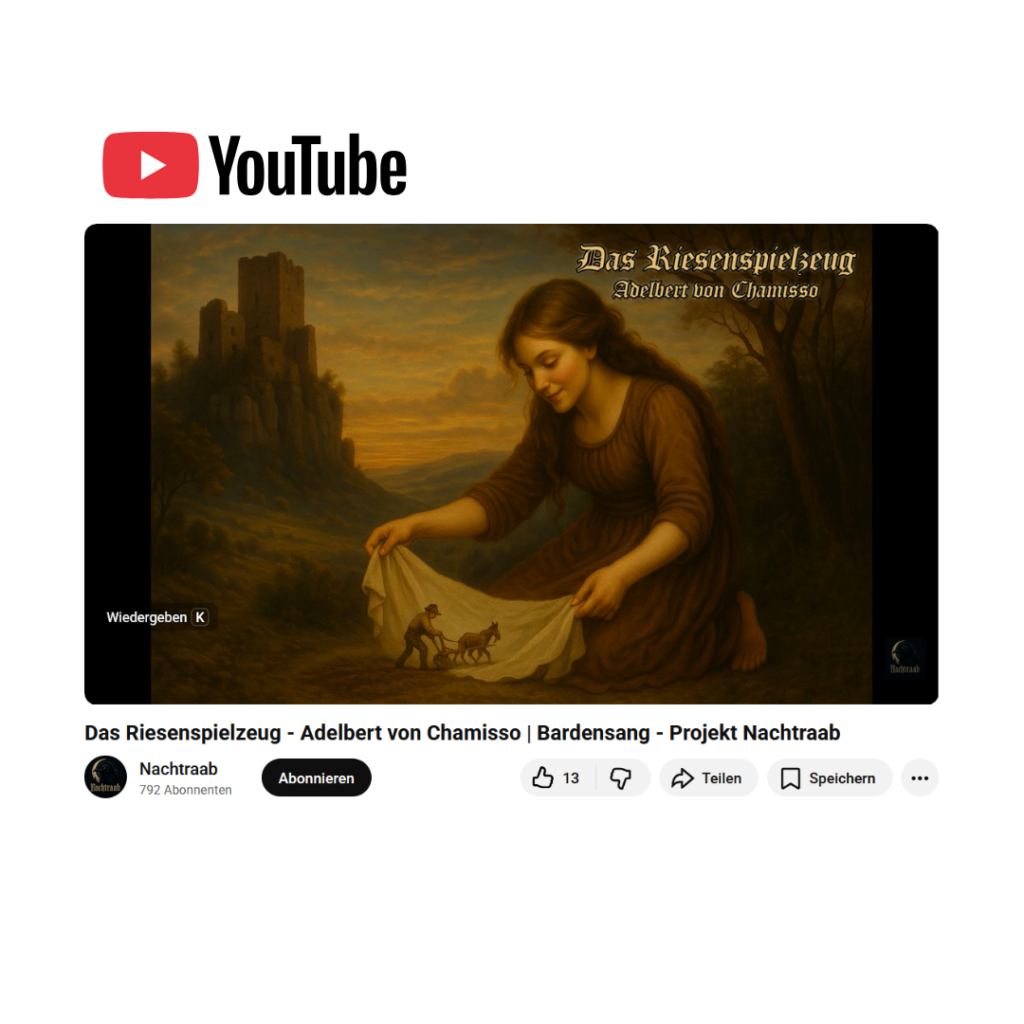
As mentioned at the beginning, this poem is also frequently used to practise recitation skills, particularly intonation, and the expression of mood. Here are several versions (YouTube videos) demonstrating different ways in which the ballad can be performed—ranging from a calm reading style to a more animated, almost theatrical interpretation or even as a song.