Das Riesenspielzeug (Adalbert VON CHAMISSO 1831)
This charming little ballad about a giant girl who mistakes a farmer for a toy is a classic in classrooms throughout German-speaking regions. It has many different aspects: technical aspects such as rhymes or the emphasis on rhythm when reading.
Other notable aspects include the changing in word choice or how they are writing in comparison to nowadays, the historical context of the region where the story is set, the deeper meaning in the story line to the father-daughter relationship, to the importance of respect towards other people.
1.
Burg Niedeck ist im Elsaß der Sage wohl bekannt,
Die Höhe, wo vor Zeiten die Burg der Riesen stand;
Sie selbst ist nun verfallen, die Stätte wüst und leer,
Du fragest nach den Riesen, du findest sie nicht mehr.
Der Elsaß (Alsace)
The very first words of this ballad grab the reader’s attention:
Unlike other stories or poems where there aren’t any specific references to the location, e.g., in a « distant kingdom » or in a « village in the Alps », etc., a specific region – the Alsace- is mentioned.
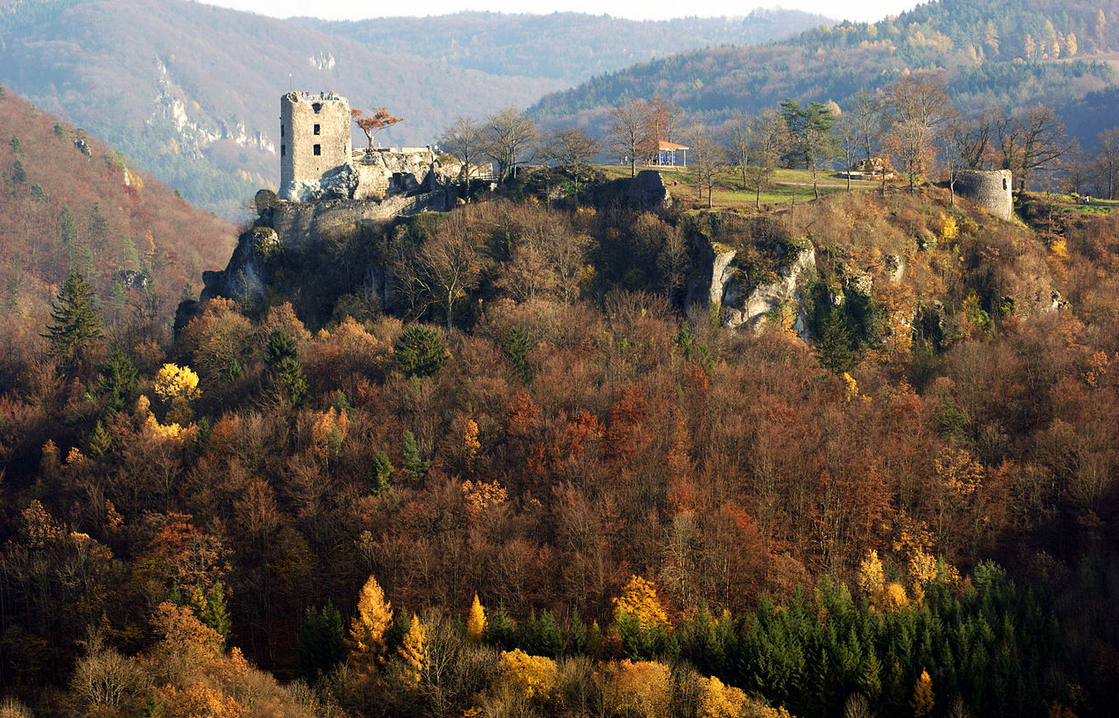
Alsace (Elsaß) is a border region between France and Germany that has belonged to both countries at different times. When this poem was written, the region, which is now part of France, belonged to Germany. In addition, the ruins of Niedeck Castle (Burg Niedeck) can still be visited – after a challenging hike up the hill.
2.
Einst kam das Riesen-Fräulein aus jener Burg hervor,
Erging sich sonder Wartung und spielend vor dem Thor
Und stieg hinab den Abhang bis in das Thal hinein,
Neugierig zu erkunden, wie’s unten möchte sein.
The evolution of the German spelling (Deutsche Rechtschreibung)
Typical for the works at this time, the early 19th century, in the German language the ‘th’ is still used as in Thor (door, which today would be written as Tor) or Thal (valley, which is written as Tal in modern German). The ‘th’ towards ‘t’ spelling got adapted during the II. Orthographischen Konferenz in 1901.
3.
Mit wen’gen raschen Schritten durchkreuzte sie den Wald,
Erreichte gegen Haslach das Land der Menschen bald,
Und Städte dort und Dörfer und das bestellte Feld
Erschienen ihren Augen gar eine fremde Welt
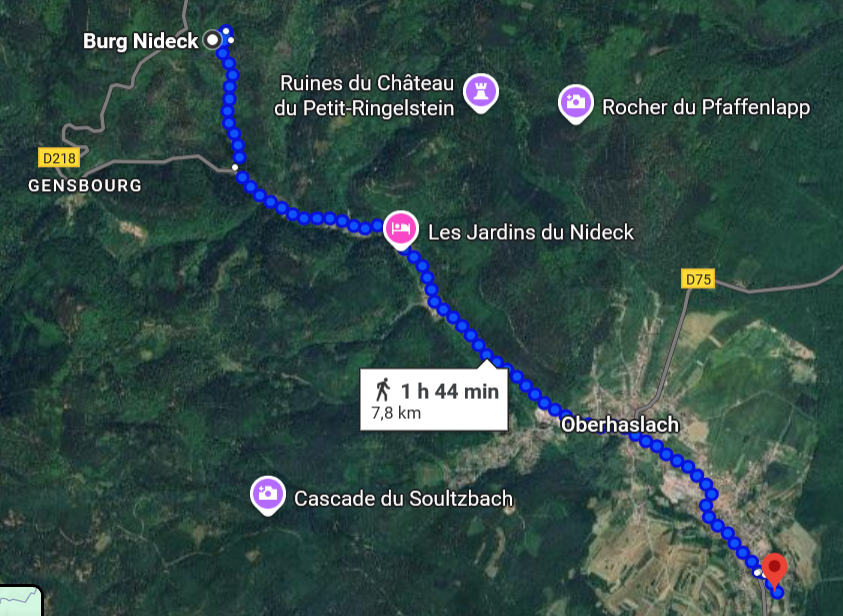
In fact, there is an Oberhaslach and a Niederhaslach near Niedeck Castle. Did the little giantess in the story perhaps take the Rue du Nideck?
If we were to take this route today, it would take us almost two hours, perhaps a little less going downhill… and for a giantess, it was just a few quick steps (« Mit wen’gen raschen Schritten… »).
4.
Wie jetzt zu ihren Füßen sie spähend niederschaut,
Bemerkt sie einen Bauer, der seinen Acker baut;
Es kriecht das kleine Wesen einher so sonderbar,
Es glitzert in der Sonne der Pflug so blank und klar.
While new words are added to the dictionary every year (inkluding the « words of the year »), « einherkriechen » is a counterexample: it does not exist in the Duden dictionary (« hineinkriechen » does, however). Here in the text, it can be equated with « walking around. » But since humans are so small compared to the giantess, they are comparable to small animals crawling around…
5.
Ei! artig Spielding! ruft sie, das nehm’ ich mit nach Haus.
Sie knieet nieder, spreitet behend ihr Tüchlein aus,
Und feget mit den Händen, was da sich alles regt,
Zu Haufen in das Tüchlein, das sie zusammen schlägt;
6.
Und eilt mit freud’gen Sprüngen, man weiß, wie Kinder sind,
Zur Burg hinan und suchet den Vater auf geschwind:
Ei Vater, lieber Vater, ein Spielding wunderschön!
So Allerliebstes sah ich noch nie auf unsern Höh’n.
It’s not only the choice of words that craft a story but also the little commentaries – you know how children are – in between that make a story vivid and sheds a light on relationships between the different characters and draws the reader in even further.
7.
Der Alte saß am Tische und trank den kühlen Wein,
Er schaut sie an behaglich, er fragt das Töchterlein:
Was Zappeliges bringst du in deinem Tuch herbei?
Du hüpfest ja vor Freuden; laß sehen, was es sei.
8.
Sie spreitet aus das Tüchlein und fängt behutsam an,
Den Bauer aufzustellen, den Pflug und das Gespann;
Wie alles auf dem Tische sie zierlich aufgebaut,
So klatscht sie in die Hände und springt und jubelt laut.
9.
Der Alte wird gar ernsthaft und wiegt sein Haupt und spricht:
Was hast du angerichtet? das ist kein Spielzeug nicht!
Wo du es hergenommen, da trag’ es wieder hin,
Der Bauer ist kein Spielzeug, was kommt dir in den Sinn!
Interestingly, there’re two synonymes for « toy » in the story: The little giantess uses « Spielding » and her father uses « Spielzeug ». While the word « Spielzeug » is still used today, « Spielding » has fallen out of fashion. However both parts « Zeug » and « Ding » can be found nowadays: « Ding » is in general « a thing », whereas « Zeug » describes the plural of things, similar to « stuff ». For instance, « put away your stuff » translates into « räum dein Zeug weg » (used coloquially).
10.
Sollst gleich und ohne Murren erfüllen mein Gebot;
Denn, wäre nicht der Bauer, so hättest du kein Brod;
Es sprießt der Stamm der Riesen aus Bauernmark hervor,
Der Bauer ist kein Spielzeug, da sei uns Gott davor!
The phrase « Denn, wäre nicht der Bauer, so hättest du kein Brod » (if it wasn’t for the farmer, you wouldn’t have bread) is the moral of the story. As bread is the staple food, it also translates to having to go hungry without it. The phrase is also often revered to in situations where someone looks down on other professions that are seemingly not as glamorous or reputable as others, in a reminder that the work done is essential and just as honorable. It is even explained that the giants in the castle once came from farmers too.
11.
Burg Niedeck ist im Elsaß der Sage wohlbekannt,
Die Höhe, wo vor Zeiten die Burg der Riesen stand,
Sie selbst ist nun verfallen, die Stätte wüst und leer,
Und fragst du nach den Riesen, du findest sie nicht mehr.