This charming little ballad about a giant girl who mistakes a farmer for a toy is a classic in classrooms throughout German-speaking regions. It has many different aspects: technical aspects such as rhymes or the emphasis on rhythm when reading.
Other notable aspects include the changing in word choice or how they are writing in comparison to nowadays, the historical context of the region where the story is set, the deeper meaning in the story line to the father-daughter relationship, to the importance of respect towards other people.
1.
Burg Niedeck ist im Elsaß der Sage wohl bekannt,
Die Höhe, wo vor Zeiten die Burg der Riesen stand;
Sie selbst ist nun verfallen, die Stätte wüst und leer,
Du fragest nach den Riesen, du findest sie nicht mehr.
Der Elsaß (Alsace)
The very first words of this ballad grab the reader’s attention:
Unlike other stories or poems where there aren’t any specific references to the location, e.g., in a « distant kingdom » or in a « village in the Alps », etc., a specific region – the Alsace- is mentioned.

Alsace (Elsaß) is a border region between France and Germany that has belonged to both countries at different times. When this poem was written, the region, which is now part of France, belonged to Germany.
In addition, the ruins of Niedeck Castle (Burg Niedeck) can still be visited – after a challenging hike up the hill.
2.
Einst kam das Riesen-Fräulein aus jener Burg hervor,
Erging sich sonder Wartung und spielend vor dem Thor
Und stieg hinab den Abhang bis in das Thal hinein,
Neugierig zu erkunden, wie’s unten möchte sein.
The evolution of the German spelling (Deutsche Rechtschreibung)
Typical for the works at this time, the early 19th century, in the German language the ‘th’ is still used as in Thor (door, which today would be written as Tor) or Thal (valley, which is written as Tal in modern German). The ‘th’ towards ‘t’ spelling got adapted during the II. Orthographischen Konferenz in 1901.
3.
Mit wen’gen raschen Schritten durchkreuzte sie den Wald,
Erreichte gegen Haslach das Land der Menschen bald,
Und Städte dort und Dörfer und das bestellte Feld
Erschienen ihren Augen gar eine fremde Welt.
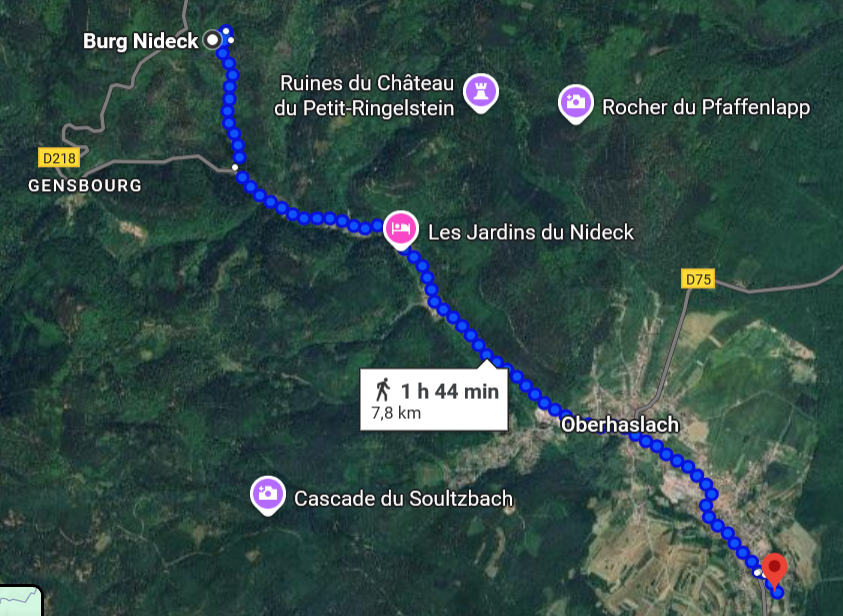
In fact, there is an Oberhaslach and a Niederhaslach near Niedeck Castle. Did the little giantess in the story probably take the Rue du Nideck? If we were to take this route today, it would take us almost two hours, perhaps a little less going downhill…